
Student Code of Conduct
Our Expectation
At zera International School, we see every student as a seed with the potential to grow, adapt, and thrive. We expect our students to embrace challenges with passion, approach learning with a spirit of curiosity, and treat others with respect and care.
Your journey here is not about perfection but progress—developing strength through setbacks, building character through actions, and growing into individuals who can make a meaningful impact. Together, let us create a community where each step forward nurtures growth, inspires excellence, and prepares you to carry your roots of wisdom into the future.
The Role of the Student
Students are at the heart of our school community. You are expected to:
- Take ownership of your actions, learning, and behaviour.
- Show respect to peers, teachers, and the school environment at all times.
- Approach challenges with a growth mindset and seek support when needed.
- Be prepared for school each day—attending on time, completing assignments, and bringing the required materials.
- Embrace mistakes as part of the learning process and respond positively to guidance.
- Treat everyone with kindness, integrity, and fairness, inside and outside of school.
- Actively participate in lessons, co-curricular activities, and school events to nurture your talents and interests.
By embodying these principles, you will grow not only as learners but also as individuals capable of making meaningful contributions to the world.
The Role of the Parents
Parents are partners in their child's growth, both academically and personally. At zera International School, we expect parents to:
- Reinforce positive behaviour and respect at home, encouraging self-discipline and independence.
- Maintain open communication with teachers and support the school's efforts to uphold shared values.
- Actively engage in their child's education by showing interest in their progress, talents, and activities.
- Collaborate with the school when interventions or additional support are needed, especially for students in zera Plus Education.
- Be aware of school rules, expectations, and processes, serving as role models for respectful and responsible behaviour.
Together, we can nurture an environment where children feel supported, valued, and encouraged to thrive.
The Role of the Teacher
Teachers are mentors, role models, and guides in the student's journey of growth and learning. At zera International School, teachers will:
- Create an inclusive, supportive environment that encourages curiosity, resilience, and self-discipline.
- Set high yet achievable expectations for all students, empowering them to reach their full potential.
- Adapt teaching strategies to suit individual needs, fostering engagement and reducing barriers to learning.
- Implement rewards and consequences consistently and fairly, with a focus on growth and learning.
- Maintain regular communication with parents to ensure collaboration in supporting each student's development.
- Identify early behavioural or academic concerns and consult with leadership or specialists, including the Head of zera Plus Education where necessary.
- Model the school's values in their actions, promoting mutual respect and positive relationships.
- By leading with integrity, care, and high expectations, teachers play a key role in inspiring students to embrace their learning journey with confidence and purpose.
Special Conduct Considerations for zera Plus Education
We understand that students in zera Plus Education may face unique challenges. When behavioural concerns arise, the Head of zera Plus Education will be consulted to ensure interventions are appropriate and meet the student's individual needs.
We approach these situations with care, recognizing that some behaviours may stem from developmental or emotional challenges.
However, the safety and well-being of all students remain our priority. If behaviours escalate to a level that poses a significant risk or demonstrates no evidence of improvement, the school reserves the right to apply the necessary interventions or sanctions in consultation with leadership.
Appearance and Attire
Attire
School Uniform
- Students must wear the complete and proper school uniform to school during class days, with shirts tucked into pants/skirts.
- School uniforms must be kept clean, and students should repair any damages or sew on missing buttons themselves.
- Boys must pair their uniforms with black belts.
- Students unable to wear the school uniform due to special reasons must apply for a special permit before class.
Sports Attire
- During physical education (PE) classes, students must wear the school's sports attire and sports shoes (if necessary).
- After PE classes, students must change back into their school uniforms and black school shoes.
Shoes
- Students must wear black socks and black shoes to school.
- Sports shoes are allowed during PE classes.
- Students unable to wear black shoes and socks due to injury must apply for a special permit before class.
Appearance
Hairstyle
- Hairstyles should be neat, simple, easy to manage, and appropriate for students.
- Students are not allowed to dye, perm, or adopt unusual hairstyles, nor shave patterns or shapes into their hair.
Boys
- Front hair should not extend beyond the eyebrows.
- Sideburns should not go beyond half the length of the ear.
- Back hair should not touch the collar.
Girls
- Front hair should not extend beyond the eyebrows.
- If the back of the hair is longer than the collar, it must be tied up.
- Hairbands and clips must be black and not overly decorative.
Face
- Boys are not allowed to keep long beards.
- Girls are not allowed to wear makeup.
- Muslim girls are permitted to wear white headscarves.
- Students are allowed to wear clear or black contact lenses, ear studs, and small round gold or silver earrings.
- Colored contact lenses, enlarging lenses, earrings (other than small round gold or silver ones), necklaces, and other accessories are not permitted.
Hands
- Students are allowed to wear watches.
- Rings, bracelets, bangles, and wristbands are not permitted.
- Students must trim their nails regularly and maintain hygiene.
- Nail polish is not allowed.
Body
- Tattoos are not permitted.
Consequences for non-compliance with the appearance and attire rules are outlined in the Inappropriate Behaviour and Consequences of Misconduct section of this handbook.
Attendance and Punctuality
Punctuality and Tardiness
Class Hours
- PLUS: 8:00 AM to 2:00 PM
- Year 1 – 6: 8:30 AM to 2:45 PM
- Class 1 – 4 / Year 7 – 9: 8:30 AM to 3:00 PM
Students unable to enter the campus before 8:10 AM without a valid explanation will be considered late (excluding PLUS students).
Leave of Absence
- Students who are unable to attend school due to personal matters or illness must follow the school's leave policy. Absences without prior approval will be treated as truancy.
Types of Leave
Sick Leave
- A valid medical certificate is required (a receipt from a medical visit is not accepted as proof).
- Full attendance rewards will not be granted.
- If the total number of sick and personal leave days exceeds one-third of the semester's school days, the student will not be allowed to participate in the semester examination.
Personal Leave
- Applications must be submitted to the school at least one day in advance.
- For emergencies, applications must be completed within five school days (excluding weekends or public holidays) starting from the day of returning to school.
- Driving tests are classified as personal leave and require proof of the test; otherwise, it will be treated as truancy.
- Full attendance rewards will not be granted.
- If the total number of sick and personal leave days exceeds one-third of the semester's school days, the student will not be allowed to participate in the semester examination.
Official Leave
- Granted for representing the school in competitions or public service events.
- A certificate or approval from the relevant teacher or unit is required, and the applicant must personally complete the leave process.
- Applications must be completed three days in advance.
- Full attendance rewards will still be granted.
Bereavement Leave
- A death certificate or obituary must be provided.
- Bereavement leave is limited to three days for immediate family members and one day for non-immediate family members.
- Immediate family members: grandparents, parents, and siblings.
- Non-immediate family members: all relatives outside of immediate family.
- Full attendance rewards will still be granted.
Special Leave
- For special exams (e.g., external music exams or government-recognized competitions or exams).
- For extraordinary circumstances (e.g., natural disasters or accidents).
- Supporting documents from relevant authorities are required.
- Full attendance rewards will still be granted.
Leave Procedures
- Parents must submit leave applications through the school's online platform, along with relevant documents or proof.
- To avoid confusion in the school's system and ensure accurate attendance records, please make sure the leave dates are filled out correctly. Applications cannot be amended after submission.
- If the submitted leave dates do not match the actual absence dates, the application will be deemed invalid, and the absence will be treated as truancy.
- Leave applications must be submitted in advance or within five school days (excluding weekends or public holidays) starting from the day of returning to school. Late submissions will be treated as truancy.
- Absences without prior approval or insufficient justification will be treated as truancy.
- If the total number of sick and personal leave days exceeds one-third of the semester's school days, the student will not be allowed to participate in the semester examination.
- Full attendance is defined as having no absences, tardiness, or truancy. Official leave, bereavement leave, and special leave are exceptions.
Consequences for violations of attendance and punctuality expectations are outlined in the Inappropriate Behaviour and Consequences of Misconduct section of this handbook.
Assessment and Homework
All students are expected to conduct assessment and academic activities such as homework with honesty and integrity, without cheating or plagiarising and appropriately acknowledge the contribution of others in all academic works. Academic integrity also includes not engaging in: cheating, plagiarism, unauthorised use of others' work, stealing assessment papers, providing answers to someone else, impersonating another candidate in assessment, stealing assessment papers and using an unauthorised calculator during an examination.
Students may sometimes work with others on assignments but are expected to work independently at other times. Each student is always individually accountable for their own learning assessments. Students are expected to demonstrate integrity at all times. Consequences for plagiarism, academic dishonesty, and cheating are outlined in the Inappropriate Behaviour and Consequences of Misconduct section of this handbook.
Encouraged Behaviour and Recognition
Stage 1: Individual Positive Effort (Weekly)
Time Frame: Weekly basis, focused on recognising small daily improvements and efforts with immediate encouragement.
Definition: Primarily centred on individual effort, the rewards are immediate, small-scale, and personalised to help students develop positive behavioural habits. The rewards in the first stage emphasise immediacy and visibility, allowing students to experience short-term recognition for their efforts and inspiring daily motivation for learning.
Learning Performance:
- Submit all assignments on time each week, with no omissions or overdue tasks.
- Show significant improvement or maintain steady progress in every quiz.
Discipline and Rule Adherence:
- Have no instances of tardiness, early departure, or leaving the seat without permission within the week.
- Wear a clean and tidy school uniform every day, adhering to school regulations.
- Stay focused during class with no distractions such as chatting or engaging in other activities.
Class Contribution:
- Actively contribute to maintaining classroom cleanliness, such as wiping the blackboard, arranging desks and chairs, or picking up litter at least once.
- Proactively offer help to classmates in need, such as lending stationery or guiding them with assignments.
Personal Character and Courtesy:
- Greet teachers and classmates proactively every day, demonstrating good manners.
- Maintain a friendly attitude both inside and outside of school, avoiding conflicts with peers.
Stage 2: Sustained Positive Performance and Contribution (Four Consecutive Weeks)
Time Frame: Continuous stable performance and progress over a period of four weeks, with rewards carrying a greater sense of honour and tangible significance.
Definition: The rewards are given for sustained mid-term efforts, enhancing the student's sense of honour and accomplishment. The rewards in this stage focus on recognising consistency and privileges, viewing the student's ongoing effort and positive behaviour as a respect-worthy achievement and motivating even higher levels of engagement.
Academic Performance:
- Complete all homework assignments for four consecutive weeks, maintaining a high quality.
- Maintain a high level of participation in class, ranking in the top 10% of the class.
- Show steady improvement or reach above-average scores in the last four quizzes.
Discipline and Rule Adherence:
- Follow all school rules for four consecutive weeks, such as not bringing toys or prohibited items to school.
- Maintain good behaviour during class for four consecutive weeks, with no violations such as leaving the seat without permission, being distracted, or chatting.
- Keep personal appearance neat and tidy, such as wearing the correct uniform, having a proper hairstyle, and wearing acceptable shoes and socks every day.
Class Contribution:
- Serve as a class group leader or coordinator for four consecutive weeks, helping the teacher manage group assignments.
- Actively participate in class cleaning duties, completing assigned tasks like sweeping the floor or wiping the desks and chairs.
- Participate in at least one volunteer activity within the school, such as campus beautification or public area maintenance.
Character and Cooperation:
- Show concern for classmates, with no conflicts, disputes, or violations of moral conduct for four consecutive weeks.
- Display good teamwork by actively contributing ideas and suggestions during group activities.
- Offer help to classmates in need, such as tutoring students who are struggling with their studies for four consecutive weeks.
Stage 3: Excellence in Performance and Long-term Contribution (Semester or Specific Period, No Fixed Time Limit)
Time Frame: No specific time limit, awarded for long-term, outstanding performance or significant contributions to the school or class.
Definition: This stage recognises long-term, exceptional, or outstanding contributions with high honours and special opportunities, motivating students to strive for excellence. Rewards in Stage 3 emphasise honour and long-term impact, helping students feel a sense of responsibility as role models and further inspiring them to continue striving to be leaders in the school.
Academic and Learning Achievements:
- Achieving top rankings in the semester's overall assessment, ranking in the top 5 of the class or excelling in a particular subject.
- Winning awards in academic competitions within the school (e.g., maths, science, writing, etc.).
- Maintaining a consistently positive learning attitude and stable or continuous improvement in academic performance.
Discipline and Exemplary Behaviour:
- No disciplinary violations throughout the entire semester and consistently setting a positive example for classmates.
- Actively assisting teachers in managing the class, such as serving as a class discipline monitor or leader of the duty roster.
- Demonstrating proactive compliance with all school regulations and influencing others to improve together.
School Contribution and Responsibility:
- Taking the initiative to organise or lead school events, such as class performances, sports days, or charity activities.
- Participating long-term in school clubs or volunteer services, such as environmental groups, library assistants, etc.
- Representing the school in external activities, competing and achieving outstanding results or honours.
Character and Team Spirit:
- Providing ongoing support to classmates in building learning confidence, such as serving as a peer tutor.
- Demonstrating excellent character and teamwork, earning the respect and trust of both teachers and classmates.
Rewards
Stage 1: Individual Positive Effort
Immediate Achievement Rewards:
- Priority choices in class, such as selecting preferred seating or having the opportunity to participate in class activities first.
- The option to act as a "class assistant" for a day, helping the teacher with simple classroom management or explanations.
- Display the names of outstanding performers of the week on the classroom bulletin board, along with a brief encouraging message.
Special Opportunities:
- Earn an extra 5-10 minutes of free learning time to read extracurricular books or choose learning resources of interest.
Stage 2: Sustained Positive Performance and Contribution
Honour and Recognition:
- Awarded the "Student of the Month" certificate, with a brief class award ceremony.
- Name and photo displayed on the school bulletin board or class "Wall of Fame," along with an encouraging message from the teacher.
- Publicly recognised during the school morning assembly or gathering, highlighting their efforts and achievements.
Exclusive Privileges:
- Receive a "No Duty Pass," allowing the student to skip class duty for one day.
Group Rewards:
- If the entire group or class performs excellently, they can earn a "Class Movie Day" or a relaxing classroom activity.
Stage 3: Excellence in Performance and Long-term Contribution
Highest Honours:
- Awarded the "Student of the Semester" certificate, with recognition during the school's award ceremony.
- Receiving a special school souvenir at the end of the semester, such as a personalised medal or trophy with their name engraved.
- Eligible to have their name displayed on the school's "Wall of Honour" as a role model to inspire other students.
Exclusive School Activities:
- Invited to participate in a special school event or excursion, such as a visit to a science museum or zoo.
Long-Term Privileges:
- Eligibility to serve as the semester's "Student Ambassador," responsible for assisting with school events and enjoying certain leadership privileges.
- Eligibility to propose a class or school welfare program (e.g., adding new classroom games or specific activities).
- Eligibility to represent the class at the end of the semester to give a speech or share reflections on learning experiences.
Inappropriate Behaviours and Consequences of Misconduct
1. Behaviours
Level 1: Low-Level Misconduct
Disrespect for Others
- Making intentional and harmful gestures, verbal or written comments, or symbols to others (verbal put-downs, cursing, talking back).
- Use of offensive language (non-directed).
Learning Environment
- Disrupting others' learning.
- Missing lesson equipment or preparation.
- Failing to complete work or meet deadlines.
Attendance and Punctuality
- Tardiness: Students who are tardy more than five (5) times in a year.
- Truancy: Being absent to school for two (2) consecutive days or five (5) non-consecutive days without any leave application.
- Early sign out without permission.
Appearance and Attire
- Violating the student dress code.
- Revealing and/or see-through garments.
- Wearing items that are vulgar, obscene, libellous, or denigrate others on account of race, religion, creed, national origin, gender, sexual orientation or disability.
- Wearing clothing displaying or suggesting profanity; sexual activity through graphic images, words, or innuendos; violence; or tobacco products.
School Environment
- Littering or improper disposal of waste.
- Chewing, eating, or drinking in unauthorised areas.
- Dress code violation (e.g., incorrect uniform).
- Unauthorised use of elevators or restricted areas.
Technology and Devices
- Unauthorised mobile phone use.
- Inappropriate use of the internet or ICT resources.
Level 2: Persistent Low-Level Misconduct
Repeated Infractions
- Repeated Level 1 behaviours, such as tardiness, littering, or dress code violations.
Escalated Respect Issues and Disruptions
- Persistent lack of respect for staff, students, or school values.
- Repeated use of offensive or obscene language.
- Continual disruption of learning or causing distractions.
- Defiance toward school rules or instructions.
Integrity and Accountability
- Petty theft.
Attendance and Punctuality
- Truancy from lessons or leaving the school premises or school-related activities without permission.
- Truancy: absent to school for five (5) consecutive days or ten (10) non-consecutive days without any leave application.
Academic Dishonesty (Assessment and Homework)
- Cheating, plagiarism, unauthorised use of others' work.
- Impersonating another candidate.
- Stealing assessment papers.
- Using an unauthorised calculator during an examination.
Harassment and Bullying
- Minor bullying, teasing, or ostracising others (verbal or physical).
- Discrimination based on race, gender, religion, or other characteristics.
Technology Misuse
- Possession or distribution of offensive material.
- Inappropriate use of recording devices on school premises.
Level 3: Serious Misconduct
Serious Infractions
- Repeated Level 2 behaviours.
- Leaving campus without authorisation or skipping school.
- Direct defiance toward staff.
Attendance and Punctuality
- Being absent to school for 20 days without any necessary documentation for absences to teacher.
Safety and Security
- Fighting or low-level violence (without significant injury).
- Threatening or intimidating behaviour.
- Tampering with safety or security devices.
- Damage to property (careless or intentional).
Harassment and Abuse
- Severe bullying, including cyberbullying.
- Racism or verbal/physical abuse toward others.
- Sexual harassment or abuse.
Integrity and Accountability
- Theft of significant value.
- Vandalism of school or personal property.
- Gambling.
- Unauthorised sale of items on school premises.
Substance Misuse
- Possession, use, or sale of tobacco, vaping devices, or alcohol.
- Misuse of social media, including online bullying or inappropriate posts.
Social Behaviour
- Public displays of affection.
Level 4: Severe and Repeated Misconduct
Repeated Serious Infractions / three or more Level 3 incidents
- Actions bringing school into disrepute.
- Serious actions off-campus that damage the school's reputation.
Extreme Safety Risks
- Assault on a teacher, staff member, or student.
- Major theft or vandalism.
- Arson.
- Possession, use, or trafficking of illegal drugs or related paraphernalia.
- Possession of a prohibited weapon.
Escalated Harassment and Misuse
- Severe bullying, extortion, or alienation of others.
- Serious misuse of social media or digital platforms.
- Indecent exposure or outrage of modesty.
Involvement in Criminal Acts
- The school strictly prohibits student involvement in criminal acts such as theft, physical assault, possession or use of illegal substances, vandalism, and cyber offences. These behaviours are considered severe violations of both the school's regulations and Malaysian law.
2.1. Intervention Framework: Supporting Positive Behaviour
Level 1: Low-Level Misconduct
Communication and Reflection
- Verbal warning, outlining concerns and potential consequences.
- Writing a letter of apology.
- Informing parents about the incident.
Supervision and Monitoring
- Alter seating plan or working groups.
- Record incident in the behaviour tracking system.
Loss of Privileges
- Withdrawal of privileges (e.g., use of recreational spaces).
- Confiscation of items used inappropriately (e.g., devices).
Community Contribution and Corrective Action
- School community tasks (e.g., tidying common areas).
- Attending support or intervention sessions.
Time-Based Consequences
- Time-out from lessons or activities.
Level 2: Persistent Low-Level Misconduct
Communication and Reflection
- Contact parents to discuss concerns and agree on intervention strategies.
- Develop an action plan to avoid further infractions.
- Join mediation sessions to resolve conflicts, if applicable.
Supervision and Monitoring
- Daily Behaviour Report to monitor conduct throughout the day.
- Short-term removal from activities for closer supervision.
- Record repeated infractions and escalate to higher-level staff.
Loss of Privileges
- Short-term loss of access to school activities (e.g., clubs or sports).
Community Contribution and Corrective Action
- In-school exclusion with tasks during break or lunch (e.g., assisting with school maintenance).
Time-Based Consequences
- Assign a short detention (e.g., 20 minutes) after school hours.
Level 3: Serious Misconduct
Communication and Reflection
- Immediate meeting with parents to address concerns and outline next steps.
- Formal written warning filed in the student's record.
Supervision and Monitoring
- Placement on a Behaviour Column in Report Card monitored by the Form Teacher or Key Stage Leader.
Loss of Privileges
- Temporary loss of privileges, such as school trips or events.
Community Contribution and Corrective Action
- Restorative actions, such as repairing damage caused by misconduct.
Time-Based Consequences
- School suspension 1 week.
Alternative Pathways and Serious Consequences
- Explore alternative educational arrangements, if necessary.
Level 4: Severe and Repeated Misconduct
Communication and Reflection
- Meeting with parents to discuss serious concerns and potential involvement of external agencies.
- Re-admittance interview (with parents) after suspension.
Supervision and Monitoring
- Placement on a Key Stage Behaviour Report Card or Assistant Head for Behaviour and Welfare's report system.
Loss of Privileges
- Suspension from school grounds for a fixed period.
- Permanent expulsion for extreme or repeated violations.
Time-Based Consequences
- Full-day in-school isolation or suspension for multiple days.
Alternative Pathways and Serious Consequences
- Fixed-term exclusion.
- Permanent expulsion for severe and repeated violations.
Escalation to Legal Authorities
- In cases of serious misconduct, the school will escalate the matter to the relevant law enforcement authorities and extend full cooperation throughout the investigation process. Parents or guardians will be duly informed.
Intervention Action Table: Escalation of Disciplinary Steps
| Step | Official Notice | Report Card | Detention Class | Parent Communication | Self-Reflection Form | Suspension |
|---|---|---|---|---|---|---|
| Level 1 — Low-Level Misconduct (1.1 & 1.2) | Verbal warning to the student. | No record on the report card. | Not applicable. | Parents will be informed of the incident. | Not required. | Not applicable. |
| Level 2 — Persistent Low-Level Misconduct (2.1 & 2.2) | Formal warning letter issued. | Misconduct is recorded. | 30-minute video reflection session. | Verbal communication with parents to discuss behaviour and next steps. | Required to be completed by the student. | Not applicable. |
| Level 3 — Serious Misconduct (3.1) | Formal warning letter issued. | Misconduct is recorded. | 1-hour after-school detention. | Mandatory parent meeting. | Required. | Not applicable. |
| Level 3 — Serious Misconduct (3.2) | Suspension letter issued. | Misconduct is recorded. | Not applicable. | Mandatory parent meeting. | Required. | 1-week suspension from school. |
| Level 4 — Severe and Repeated Misconduct (4.1) | Suspension letter issued. | Misconduct is recorded. | Not applicable. | Mandatory parent meeting. | Required. | 2-week suspension from school. |
| Level 4 — Severe and Repeated Misconduct (4.2) | Expulsion letter issued. | Not applicable. | Not applicable. | Not applicable. | Not applicable. | Permanent expulsion from school. |
Student Support and Communication Process
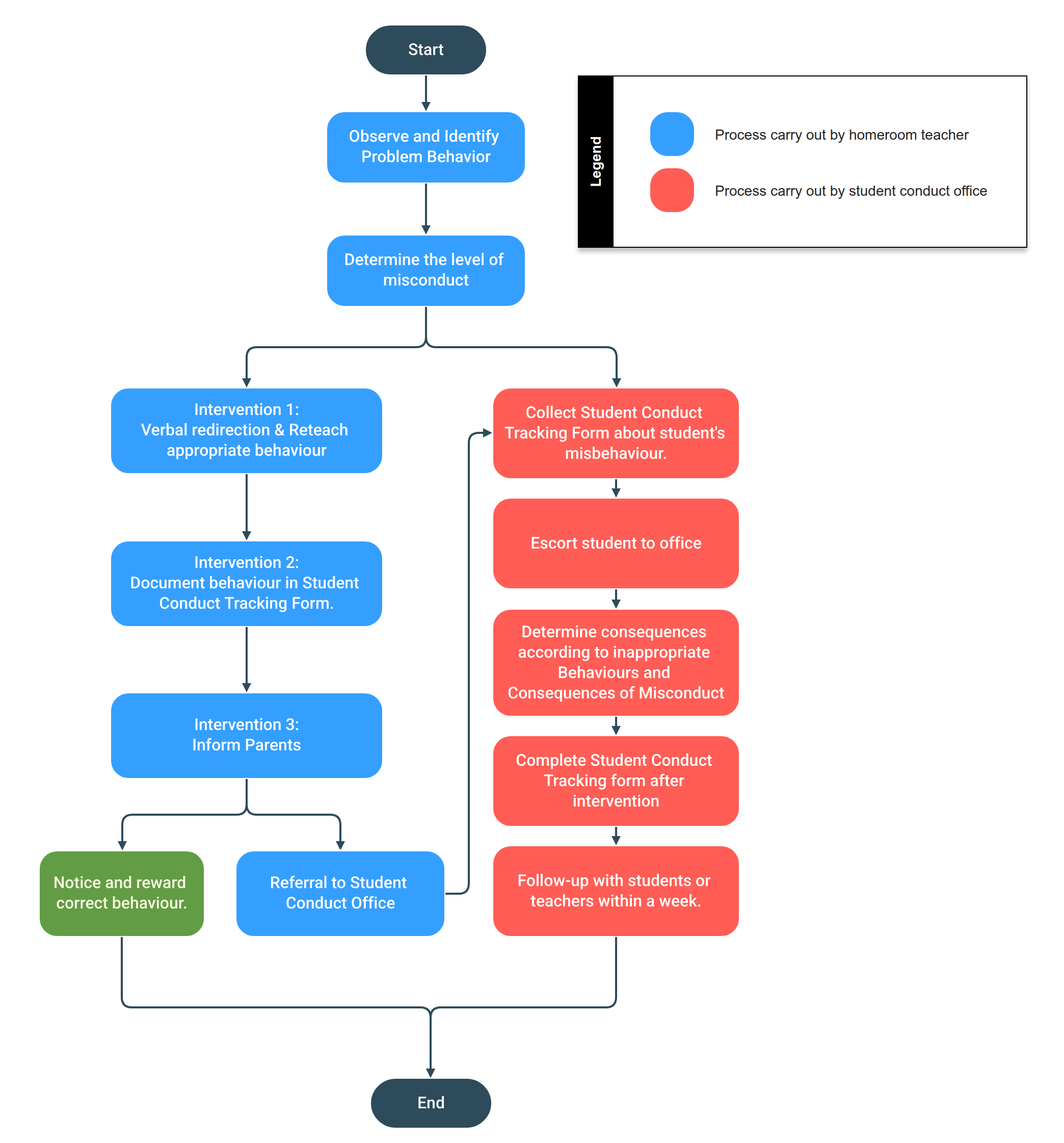
The process begins when a teacher observes and identifies a problem behaviour and determines the level of misconduct. From there it follows one of two tracks:
Homeroom teacher track
- Intervention 1 — Verbal redirection and reteaching of appropriate behaviour.
- Intervention 2 — Document the behaviour in the Student Conduct Tracking Form.
- Intervention 3 — Inform parents.
- Either notice and reward correct behaviour, or refer to the Student Conduct Office.
Student Conduct Office track
- Collect the Student Conduct Tracking Form about the student's misbehaviour.
- Escort the student to the office.
- Determine consequences according to Inappropriate Behaviours and Consequences of Misconduct.
- Complete the Student Conduct Tracking Form after intervention.
- Follow up with students or teachers within a week.
Resources
For Homeroom Teachers
- Student Conduct Record Form
For Students or Parents
- Incomplete Uniform Permission Slip
- Leave or Early Sign Out Application Form
- Self-Reflection Form
- Detention Class 30 mins Video
For Student Conduct Office
- Formal Warning Letter Template
- Suspension Letter Template
- Expulsion Letter Template
- Certificate of Recognition
School Support
- Wall of Honour
- Student Conduct Record Folder